
Weekly Mortgage Market Update: Mortgage Rates Jumped This Week, But Found a Ceiling
Last week’s calm in the bond market gave way to a more volatile shift, and that change showed up quickly in mortgage pricing. Monday extended the same tight range driven by stable mortgage-backed securities. However, by Tuesday and Wednesday, selling pressure increased as Treasury yields and MBS prices moved in the wrong direction for rates.
The 10-year Treasury yield rose above 4.4% midweek as oil prices surged and inflation concerns resurfaced, exerting direct upward pressure on mortgage rates. At the same time, mortgage rates climbed back into the mid-6% range, reversing some of the improvement seen earlier in April. Mortgage-backed securities followed that same pattern. When investors sold bonds and MBS, pricing worsened, and lenders repriced higher, in some cases intraday.
By Thursday and Friday, markets found a bit of footing. Bond yields pulled back slightly, and MBS stabilized, allowing rates to recover modestly from their midweek highs. Even with that improvement, the broader trend remains clear. Rates are still being driven more by global events and inflation expectations than by traditional economic data.
For buyers and homeowners across Raleigh and North Carolina, this type of movement matters. A swing of even 0.10% to 0.20% in mortgage rates can change your monthly payment and overall affordability. What looked like a stable rate environment one week can shift quickly the next, especially when the bond market reacts to headlines instead of scheduled data.
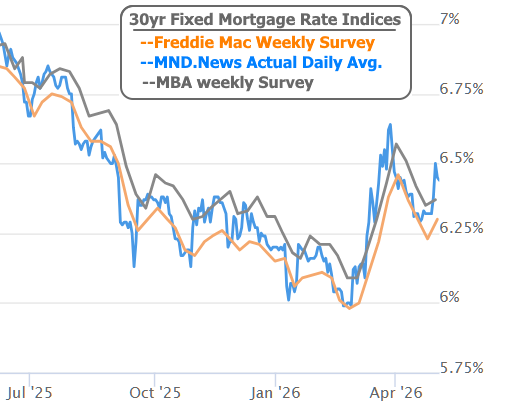
Tuesday’s rate spike followed news that the U.S. was not happy with Iran’s latest peace proposal. Wednesday morning added momentum on reports that the administration met with oil executives to assess the impact of a prolonged blockade on the Strait of Hormuz.
Right from the start, the market impact of the Iran war has centered around the free flow of shipping traffic, particularly that of oil and other energy commodities. This is why oil prices have continued to correlate so well with bond yields (which, in turn, correlate extremely well with mortgage rates).
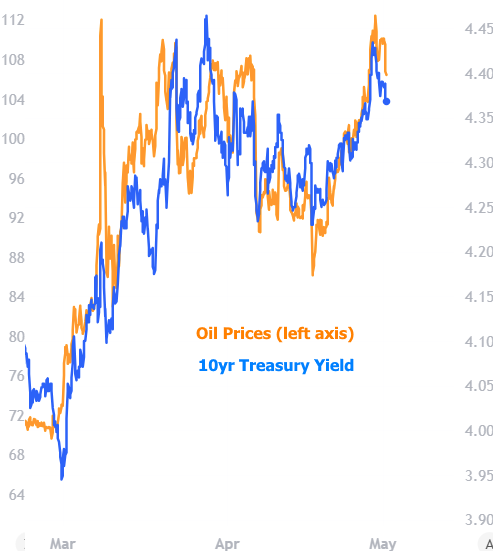
By the end of the week, the latest reports suggested some improvement in the prospects for a peace deal, hence the modest drop in oil prices and bond yields seen at the end of the chart above.
Powell’s Last Fed Press Conference, But Not His Last Meeting
This week also brought the latest Fed announcement. There was no chance that we’d see a rate hike or cut at this meeting, so the focus was instead on changes in the Fed’s verbiage, the voting breakdown, and the press conference. Markets focused on the fact that 3 Fed members voted against the verbiage of Wednesday’s statement because they feel the Fed should be doing more to acknowledge the risks that rates could move up OR down, depending on inflation in the coming months. Bond yields pushed just a bit higher in response, but more than 80% of the day’s damage had already been done by war-related news.
Less of a concern for markets, but more interesting was the announcement by Fed Chair Powell that he will remain on the Fed board after Warsh becomes the Fed Chair. He’ll be the first Fed Chair to do this since Eccles in 1948. The decision was tied to the fact that the DOJ’s investigation into Fed building renovation costs (ironically, the Eccles building) could still be reopened.
No Jobs Report?
The first Friday of any given month almost always involves the release of the big jobs report–the most important piece of monthly economic data for the bond market. This isn’t the case today, but the market was aware of this fact months ago. When Friday falls on the first day or two of a new month, and if the previous month had a lower business day count, the BLS (the agency that publishes the data) doesn’t have enough time to do all the required work on the report. In the current case, it will be released next Friday, capping a more active week for economic data and Fed speeches.
While economic data can certainly have an impact, it continues to be the case that bigger, more lasting market impacts are more likely to come from major developments in the Iran war.
Upcoming Economic Reports That Could Move Mortgage Rates in North Carolina
Next week’s economic calendar carries real weight for mortgage rates because it focuses heavily on two drivers the bond market is watching closely right now. Labor market strength and inflation signals are tied to services activity.
Here is how each report could move markets and impact mortgage rates for buyers and homeowners in Raleigh and across North Carolina.
ISM Non-Manufacturing (Services) PMI
This report tracks the largest part of the U.S. economy. Services account for more than two-thirds of economic activity.
- If the index stays strong or moves higher, it signals continued economic growth and persistent inflation pressure
- The “prices paid” component is critical. Rising input costs point directly to inflation risk
- Strong data typically pushes bond yields higher and mortgage rates up
- A weaker reading suggests slowing demand, which helps rates improve
Right now, elevated energy costs are already pushing input prices higher. That increases the stakes for this report.
JOLTS Job Openings
This report provides a deeper look into labor demand beyond headline job growth.
- A drop in job openings signals cooling demand for workers
- Fewer openings reduce wage pressure and help ease inflation
- That would support lower bond yields and better mortgage pricing
- A stronger reading reinforces a tight labor market and keeps pressure on rates upward
Forecasts already point to a slight decline, which suggests a gradual cooling, rather than a collapse.
New Home Sales
This is one of the most direct housing-related indicators.
- Higher sales show buyers are still active despite current rate levels
- That supports economic growth and can keep rates elevated
- A weaker reading signals affordability pressure and slowing demand
- That type of slowdown tends to help mortgage rates stabilize or move lower
For North Carolina markets like Raleigh, where inventory and demand remain tight, this report helps confirm whether buyers are still pushing forward or starting to pull back.
ADP Employment Report
This is an early preview of the broader jobs report.
- Strong job growth points to economic resilience and inflation risk
- Weak job growth suggests slowing momentum
- Markets use this as a directional signal ahead of Friday’s payrolls
Recent trends show modest improvement, but not a strong labor surge.
Weekly Jobless Claims
This is one of the most real-time indicators in the market.
- Low claims signal a stable labor market and continued hiring
- Rising claims indicate potential cracks in employment
- A steady or improving trend keeps pressure on rates
- A meaningful spike would support lower rates
Current data shows a stable but not accelerating labor market.
Non-Farm Payrolls and Unemployment Rate
This is the most important report of the week.
- Payroll growth well above expectations pushes rates higher quickly
- A weaker report supports bond buying and lower mortgage rates
- The unemployment rate helps confirm the broader trend
- Wage growth within the report is a key inflation signal
Forecasts show a sharp slowdown in job creation compared to last month. That sets up potential volatility depending on how the data comes in.
Consumer Sentiment
This report reflects how consumers feel about the economy and inflation.
- Falling sentiment often ties to higher costs and economic stress
- Weak confidence can signal reduced spending ahead
- That tends to support lower rates over time
Recent readings have been near historic lows, driven in part by rising fuel costs.
What This Means for Mortgage Rates in Raleigh and Across NC
This week is not about one report. It is about whether the data confirms a slowing economy or proves that inflation and labor strength are still holding firm.
- Strong data across the board pushes mortgage rates higher
- Weak data opens the door for rate improvement
- Mixed data keeps rates volatile and range-bound
Right now, markets are already on edge due to global uncertainty and energy prices. That means any surprises within the data, especially Friday’s jobs report, can impact mortgage rates quickly.
For buyers and homeowners across North Carolina, this is a key window. Market direction should become clearer as this data hits, and rate movement often follows quickly once a trend takes hold.
This is where preparation matters. You want a clear plan before rates move.
The Raleigh Mortgage Team at Certified Home Loans is here to help you stay ahead. We walk through your goals, structure the right strategy, and position you to act quickly when opportunities present. Whether you are buying or refinancing, we offer a full range of loan options, including Conventional, USDA, VA, FHA, Jumbo, and Non-QM programs.
If you are thinking about your next move, now is the time to get clarity and a plan in place.
Recently Released Economic Data
| Time | Event | Period | Actual | Forecast | Prior |
|---|---|---|---|---|---|
| Tuesday, Apr 28 | |||||
| 9:00 | Case Shiller Home Prices-20 y/y (% ) | Feb | 0.9% | 1.1% | 1.2% |
| 9:00 | FHFA Home Prices y/y (%) | Feb | 1.7% | 1.6% | |
| 10:00 | CB Consumer Confidence (%) | Apr | 92.8 | 89 | 91.8 |
| Wednesday, Apr 29 | |||||
| 8:30 | Durable goods (%) | Mar | 0.8% | 0.5% | -1.4% |
| 14:00 | Fed Interest Rate Decision | 3.75% | 3.75% | 3.75% | |
| Thursday, Apr 30 | |||||
| 8:30 | Jobless Claims (k) | Apr/25 | 189K | 215K | 214K |
| 8:30 | PCE (y/y) (%) | Mar | 3.5% | 3.5% | 2.8% |
| 8:30 | Core PCE (y/y) (%) | Mar | 3.2% | 3.2% | 3% |
| 8:30 | GDP (%) | Q1 | 2.0% | 2.3% | 0.5% |
| 9:45 | Chicago PMI | Apr | 49.2 | 53 | 52.8 |
| Friday, May 01 | |||||
| 10:00 | ISM Manufacturing PMI | Apr | 52.7 | 53 | 52.7 |
Upcoming Economic Data
| Time | Event | Period | Forecast | Prior | |
|---|---|---|---|---|---|
| Tuesday, May 05 | |||||
| 10:00 | ISM N-Mfg PMI | Apr | 53.8 | 54.0 | |
| 10:00 | USA JOLTS Job Openings (ml) | Mar | 6.87M | 6.882M | |
| 10:00 | New Home Sales (ml) | Mar | 0.668M | ||
| Wednesday, May 06 | |||||
| 8:15 | ADP jobs (k) | Apr | 79.0K | 62K | |
| Thursday, May 07 | |||||
| 8:30 | Jobless Claims (k) | May/02 | 199K | 189K | |
| Friday, May 08 | |||||
| 8:30 | Unemployment rate mm (%) | Apr | 4.3% | 4.3% | |
| 8:30 | Non-Farm Payrolls (k) | Apr | 73K | 178K | |
| 10:00 | Consumer Sentiment (ip) | May | 49.5 | 49.8 | |