
Weekly Mortgage Market Update: Raleigh Mortgage Rates React to Inflation, Jobs Data, and Global Markets
Raleigh Mortgage Rates Got the Memo
A more formal peace agreement will be significantly longer than one page and will require a considerable amount of time to negotiate. If parties can agree, in principle, on the ultimate details, it allows the war to end immediately rather than wait for the formal agreement.
Why do rates like this news?
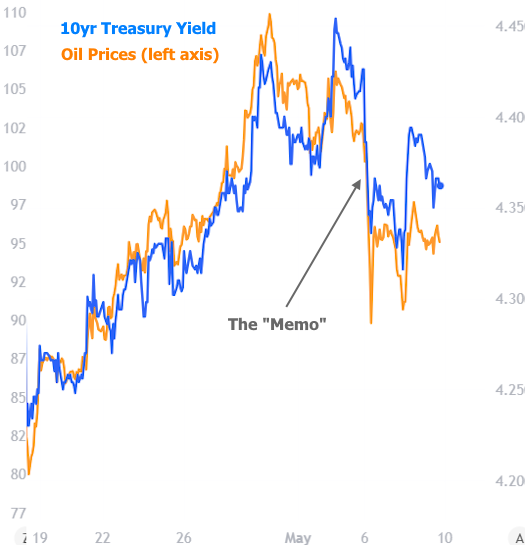
Rates are based on bonds. Inflation is bad for bonds (i.e., it pushes rates higher). Higher oil prices contribute to higher inflation. And, of course, the war has been responsible for a huge surge in oil prices. Thus, ending the war should result in relatively lower oil prices, inflation, and rates.
We’ve seen this dynamic play out frequently since the start of the war. It’s easiest to see when we use 10-year Treasury yields as a proxy for mortgage rates because mortgage rates are only updated 1-3 times each day.
How did mortgage rates react?
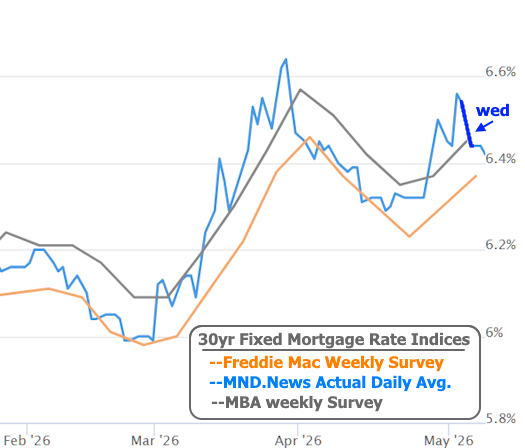
Mortgage rates began the week at the highest levels in more than a month. Wednesday singlehandedly took average daily rates back to last Friday’s levels, according to MND’s daily rate index. Meanwhile, weekly rate surveys (which don’t capture movement in a timely way) showed rates moving higher.
What about the rest of the week?
This weekly newsletter would normally have quite a lot to say about Friday’s jobs report. The payroll count came in at 115k versus a median forecast of 62k. At almost any other time in history, this would be a surefire recipe for a rapid rate spike to end the week.
Labor market trends have shifted in recent months, making the payroll report less reliable as a standalone indicator than the unemployment rate, which came in exactly as expected at 4.3%.
Labor market dynamics aside, the rate market is really preoccupied with the war and oil prices. All of the above allowed rates to drift a tick lower on Friday.
What’s next that may impact Raleigh Mortgage Rates?
As markets continue to react to geopolitical headlines and key inflation reports, the next several days could factor into the direction of mortgage rates across Raleigh and the broader North Carolina housing market. Tuesday’s Consumer Price Index and Wednesday’s Producer Price Index will give investors a fresh look at inflation pressures tied to energy costs, supply chains, and consumer demand. If inflation shows signs of easing, mortgage rates could improve. If price pressures remain elevated, rates may stay volatile. For homebuyers and homeowners considering a refinance, staying ahead of these market shifts matters. The team at Certified Home Loans is here to help you navigate changing Raleigh mortgage rates with personalized guidance and competitive Conventional, FHA, VA, USDA, Jumbo, and Non-QM mortgage options.
Visit Certified Home Loans to explore today’s mortgage solutions and connect with a trusted local mortgage broker serving Raleigh and communities across North Carolina.
Recently Released Economic Data
| Time | Event | Period | Actual | Forecast | Prior |
|---|---|---|---|---|---|
| Tuesday, May 05 | |||||
| 10:00 | New Home Sales (ml) | Mar | 0.682M | 0.65M | 0.587M |
| Wednesday, May 06 | |||||
| 8:15 | ADP jobs (k) | Apr | 109K | 99K | 62K |
| Thursday, May 07 | |||||
| 8:30 | Jobless Claims (k) | May/02 | 200K | 205K | 189K |
| 11:00 | Consumer Inflation Expectations | Apr | 3.6% | 3.4% | |
| Friday, May 08 | |||||
| 8:30 | Unemployment rate mm (%) | Apr | 4.3% | 4.3% | 4.3% |
| 8:30 | Non-Farm Payrolls (k) | Apr | 115K | 62K | 178K |
| 10:00 | Consumer Sentiment (ip) | May | 48.2 | 49.5 | 49.8 |
Upcoming Economic Data
| Time | Event | Period | Forecast | Prior | |
|---|---|---|---|---|---|
| Monday, May 11 | |||||
| 10:00 | Existing home sales (ml) | Apr | 4.05M | 3.98M | |
| Tuesday, May 12 | |||||
| 8:30 | y/y Headline CPI (%) | Apr | 3.4% | 3.3% | |
| Wednesday, May 13 | |||||
| 8:30 | PPI y/y | Apr | 4% | ||
| Thursday, May 14 | |||||
| 8:30 | Import prices mm (%) | Apr | 1.1% | 0.8% | |
| 8:30 | Jobless Claims (k) | May/09 | 205K | 200K | |
| 8:30 | Retail Sales (%) | Apr | 1.7% | ||
| Friday, May 15 | |||||
| 8:30 | NY Fed Manufacturing | May | 8.1 | 11.00 | |
| 9:15 | Industrial Production (%) | Apr | 0.2% | -0.5% | |