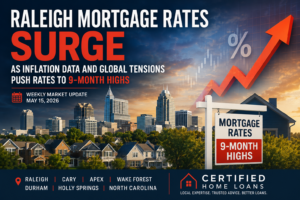
Weekly Mortgage Market Update: Raleigh Mortgage Rates Surge as Inflation Data and Global Tensions Push Rates to 9-Month Highs
Mortgage rates moved sharply higher this week as inflation fears intensified and global tensions continued to pressure the bond market. The average 30-year fixed mortgage rate climbed another 0.23% this week alone, pushing rates to their highest levels in roughly nine months.
For homebuyers and homeowners across Raleigh, Cary, Apex, Wake Forest, Durham, Holly Springs, and the rest of North Carolina, the latest rate movement serves as another reminder of how quickly mortgage markets can change.
After improving steadily earlier this year, mortgage rates have now erased nearly all of those gains. The primary driver behind the recent increase continues to be inflation fears tied to the ongoing Iran conflict and rising oil prices.
At the center of the story is the bond market.
Mortgage rates are heavily influenced by bond yields, particularly the 10-year Treasury yield and mortgage-backed securities. When inflation expectations rise, bond investors demand higher yields to offset the future loss of purchasing power. Higher bond yields translate directly into higher mortgage rates.
This week delivered several economic reports that reinforced inflation fears.
Inflation Data Continues to Pressure Mortgage Rates
Tuesday’s Consumer Price Index report showed inflation accelerating faster than economists expected. Annual CPI rose to 3.8%, while Core CPI reached its highest annual reading since 2025.
Wednesday’s Producer Price Index report delivered even more concerning inflation data. Producer inflation surged to 6.0% year-over-year, marking the highest reading since 2022. Core PPI also climbed to 5.2%.
These reports confirmed what bond markets had already been anticipating since oil prices began climbing after the start of the Iran conflict.
For mortgage markets, inflation remains one of the biggest threats to lower interest rates.
When inflation rises:
- Treasury yields typically increase
- Mortgage-backed securities weaken
- Mortgage lenders raise rates to offset risk
- Home affordability declines as payments rise
The market reaction was immediate. By Friday afternoon, the 10-year Treasury yield had climbed to its highest level in nearly a year.
Why the Bond Market Reacted So Aggressively
Friday brought the biggest market movement for the week, after hopes faded for a diplomatic breakthrough involving China and Iran. Many traders had hoped the Trump-Xi summit would produce signs of progress toward reducing geopolitical tensions and stabilizing oil markets. When the summit ended without meaningful developments, bond yields quickly edged higher. Markets tend to react to expectations before economic damage fully appears in the data. Investors had already anticipated inflation pressure from rising energy prices, and this week’s inflation reports validated those concerns. Another issue pressuring rates higher is government debt issuance. Wars and geopolitical instability often increase government spending needs. Increased Treasury issuance creates more supply entering the market. When supply rises, yields typically move higher to attract buyers. That combination of rising inflation and increased debt supply created significant upward pressure on mortgage rates this week.
Mortgage Rates in Raleigh and North Carolina
For buyers in Raleigh and across North Carolina, the recent rate increase has meaningful affordability implications.
A borrower purchasing a $500,000 home today with 10% down is facing substantially higher monthly payments compared to only a few months ago.
That shift is especially important for:
- First-time homebuyers
- FHA borrowers
- VA buyers
- Jumbo loan clients
- Move-up buyers balancing higher prices and higher rates
Many buyers entering the spring and summer housing market expected rates to continue drifting lower after the improvement seen earlier this year. Instead, markets have reversed sharply over the past several weeks. Despite higher rates, purchase activity across the Triangle remains relatively resilient due to continued housing demand and limited inventory in many price points. Borrowers should also remember that mortgage strategy matters more during volatile markets. Programs such as temporary buydowns, seller concessions, adjustable-rate mortgages, and refinance planning are becoming increasingly important tools for affordability. Homebuyers exploring payment reduction strategies should review options like a seller-paid buydown, which has become increasingly popular in the current market environment.
Mortgage Spreads Have Helped Limit Damage
One reason mortgage rates have not risen even more dramatically is due to stronger demand for mortgage-backed securities from Fannie Mae and Freddie Mac. The spread between mortgage rates and Treasury yields narrowed slightly this week, helping soften the increase consumers ultimately saw. Without that improvement in mortgage spreads, retail mortgage rates likely would have climbed even higher. This remains an important trend to watch moving forward because mortgage spreads have been unusually volatile over the past two years.
What Raleigh Homebuyers Should Watch Next Week
Markets will continue watching several key economic reports next week, including:
FOMC Minutes
- Investors will closely analyze the latest Federal Reserve meeting minutes for any signs regarding future rate policy and inflation concerns.
Housing Data
- Building permits, housing starts, and pending home sales reports will provide additional insight into the strength of the housing market despite elevated borrowing costs.
Consumer Sentiment
- Consumer confidence remains an important indicator of future spending activity and broader economic momentum.
- If inflation data continues to surprise to the upside, mortgage rates could remain elevated or move even higher in the near term.
- If geopolitical tensions ease and inflation moderates, rates could stabilize and improve.
- What This Means for Buyers and Homeowners Right Now
Market volatility creates challenges, but it also creates opportunities for prepared buyers.
For many borrowers across North Carolina, waiting for dramatically lower rates may not be the best strategy if home prices continue rising and inventory remains limited.
Instead, buyers should focus on:
- Monthly payment comfort
- Long-term financial goals
- Loan structure flexibility
- Future refinance opportunities
Many homeowners are also reviewing refinance scenarios to determine whether debt consolidation, cash-out refinancing, or mortgage insurance removal still makes sense in today’s market.
Certified Home Loans Raleigh Mortgage Market Outlook
This week served as another reminder of how quickly mortgage rates can change when inflation concerns and global events collide. Markets remain highly sensitive to economic data, Federal Reserve policy expectations, and geopolitical developments, and this week’s sharp rise in rates exhibited how rapidly bond markets react when inflation fears arise. For homebuyers and homeowners across Raleigh, Cary, Apex, Wake Forest, Durham, Holly Springs, Greensboro, and throughout North Carolina, preparation and strategy are imperative in today’s market.
Even small changes in mortgage rates can significantly affect monthly payments, buying power, and long-term affordability. At Certified Home Loans, we track mortgage markets daily to help our clients navigate these changes with confidence. Whether you’re buying your first home, refinancing, purchasing investment property, or exploring Jumbo, FHA, VA, USDA, or Conventional Financing options, having the right mortgage strategy is essential during times of market volatility.
If you are thinking about buying or refinancing in North Carolina, now is a great time to review your options, assess payment scenarios, and plan your timing before the next market shift.