FHA vs. Conventional Loans in Raleigh, NC: Which Is Better for You in 2026?
FHA vs. Conventional in Raleigh, NC, is the most common question that arrives with many assumptions already baked in, and those assumptions are usually incorrect. At Certified Home Loans, we conduct this comparison with buyers across Wake County every week, and the right answer rarely aligns with the one the buyer initially provided.
Most people treat it as a simple product comparison. Two loan types. Monthly payment on the left, monthly payment on the right, and pick the one with the lower number. What that thought process misses is mortgage insurance duration, reserve position after closing, how the loan type interacts with offer strategy in competitive Triangle submarkets, and whether a low or zero-down FHA path changes the decision entirely for buyers who haven’t yet accumulated a full down payment.
The loan that appears to be more expensive in month one is sometimes the smarter choice by year three. The one that seems like the obvious play can sometimes cost more than any of the early models predict.
FHA vs. Conventional Raleigh, NC: Which Is Better for You?
- FHA vs. Conventional is a strategy decision — the monthly payment alone does not answer it.
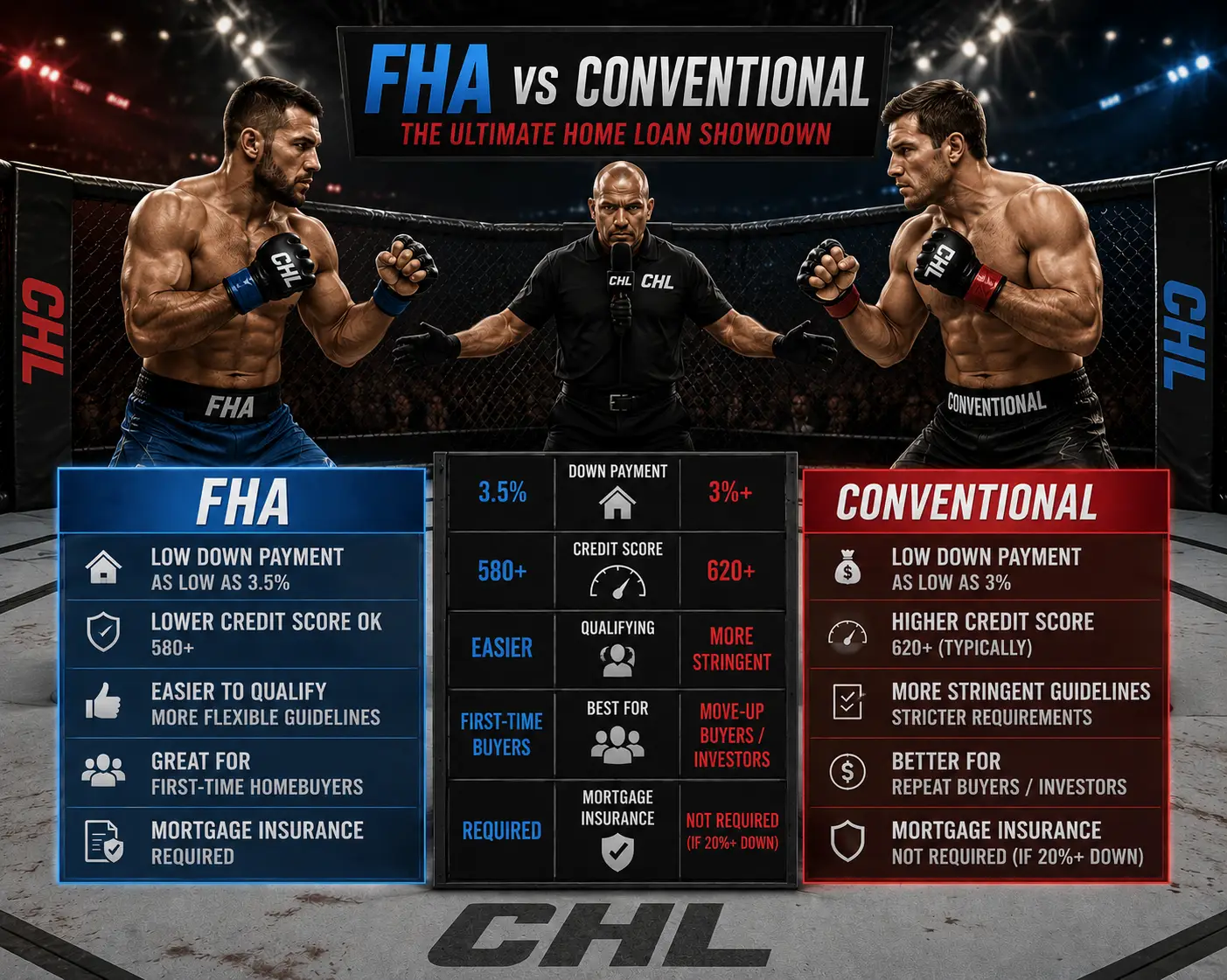
- FHA requires 3.5% down with a 580+ credit score; Conventional starts at 620, with meaningfully better pricing above 740.
- The 2026 Wake County FHA loan limit is $541,287 for a single-unit property.
- Conventional PMI ends when the loan-to-value ratio reaches 20%; FHA mortgage insurance typically stays for the life of the loan when less than 10% is put down.
- Sellers in Raleigh, Cary, Apex, and Holly Springs respond to approval quality — not loan type.
- Qualified first-time buyers in Raleigh may have access to a zero-down FHA path that covers the 3.5% requirement.
- The right answer requires modeling credit score, cash reserves, mortgage insurance exposure, and timeline — not a rule of thumb.
What This Decision Actually Involves
The comparison starts with two loan structures that serve different borrower profiles, handle mortgage insurance differently, and produce different outcomes depending on how long the buyer stays in the home.
An FHA loan is government-backed, insured by the Federal Housing Administration, and designed to allow broader access to homeownership financing. It accepts lower credit scores, permits higher debt-to-income (DTI) ratios, and requires a minimum 3.5% down payment for buyers with a 580 or higher credit score. The tradeoff is mortgage insurance that, in most cases, when less than 10% is put down, stays for the life of the loan.
A Conventional Loan follows Fannie Mae and Freddie Mac guidelines, is not government-backed, and typically requires a stronger credit profile. Private Mortgage Insurance (PMI) is required when putting down less than 20%, but it cancels automatically when equity reaches 20%, either through scheduled payments or appreciation. If you plan to keep your home for several years, mortgage insurance should play a major role in your loan decision. The difference between FHA mortgage insurance and Conventional private mortgage insurance often has a meaningful impact on your total financing costs.
Neither loan wins universally. The right one depends on where a buyer sits across four key variables: credit score, down payment, debt-to-income ratio, and expected time in the home.
The Four Variables That Drive the Decision in the Triangle
Understanding how these loan programs work in North Carolina, specifically in the Triangle, means looking at each variable in context, not through a national-average lens.
1. Credit Score
FHA qualifies borrowers at 580 for the 3.5% down path. Conventional typically starts at 620, with meaningfully better pricing beginning around 720 to 740. A buyer with a 695 score may have access to both programs, but the cost structure between them at 695 is very different from what it is at 750, and that difference compounds over a five-year hold.
2. Mortgage Insurance
This is where the long-term math separates most sharply. On a Conventional loan, PMI ends at 20% equity. On an FHA loan with less than 10% down, mortgage insurance stays for the life of the loan. On a $450,000 purchase in Raleigh at 2026 rates, with 3.5% down, that duration difference is not a rounding error; it is a material line item that changes which loan is actually cheaper over any realistic holding period.
3. Debt-to-Income Flexibility
FHA allows DTI ratios up to 57% with compensating factors. Conventional programs generally cap between 45% and 50%. A buyer carrying a car payment, student loans, and a modest credit card balance may find one program produces a qualifying loan amount while the other does not.
4. The 2026 Wake County FHA Loan Limit
The 2026 FHA loan limit for Wake County is $541,287 for a single-unit property. Buyers targeting homes above that threshold move into Conventional or Jumbo Mortgage territory regardless of credit preference. Below this threshold, both FHA & Conventional programs are live and worth modeling carefully.
2026 FHA Loan Limits for Select North Carolina Counties:
- Wake County (Raleigh/Cary/Apex) $541,287
- Durham County $634,800
- Mecklenburg County (Charlotte) $541,287
- Orange County (Chapel Hill) $634,800
- Johnston County $541,287
- Chatham County $634,800
Conventional loans have no county-level cap at standard conforming loan limits. The 2026 Conventional Conforming Loan limit is $832,750 for a single-unit property.
How Offer Strength Works in Raleigh, Cary, and Apex
The belief that Conventional automatically produces a stronger offer in the Triangle is widespread. It is also incomplete.
What sellers in Cary, Apex, Holly Springs, Wake Forest, and competitive Raleigh neighborhoods actually respond to is certainty. They want to know the financing is real, the lender has done the work, and the transaction will close on time. A well-documented FHA approval from a lender with a strong track record of clean closings competes effectively. A thin Conventional pre-qualification letter with no depth behind it does not.
At Certified Home Loans, we position our buyers with fully underwritten approvals before they ever write an offer. By completing the underwriting work upfront, we remove the financing uncertainty that sellers actually worry about — and we do that regardless of whether the underlying loan is FHA or Conventional. The approval quality is the louder signal. The loan type label is secondary.
A buyer who has been told to choose Conventional simply to be more competitive in the Triangle deserves to hear that the real advantage comes from preparation, not program selection.
Is FHA or Conventional better in a competitive Raleigh market?
Neither is automatically better. What determines offer strength is approval quality, not loan type. An FHA offer backed by complete underwriting and documented reserves can win against a Conventional offer that is thinner on preparation. Sellers in Cary, Apex, and Holly Springs evaluate certainty above all else. The team at Certified Home Loans is built to deliver that certainty, regardless of which program is behind the offer, giving buyers the strongest possible position before they write a single word on a contract.
If This Is Your First Home Purchase in Raleigh
The FHA vs. Conventional comparison takes on a specific dimension for first-time buyers in the Triangle, and there is often a third path in that conversation that most buyers never hear about.
The standard FHA path requires 3.5% down. On a $450,000 home near the Raleigh median as of mid-2026, that is $15,750 before closing costs. For many first-time buyers, that figure represents months or even years of additional saving that delay the purchase.
Certain North Carolina down payment assistance programs, including NC Home Advantage Mortgage through the NC Housing Finance Agency, can cover some or all of that 3.5% requirement through a structured second loan or grant for qualified buyers. This allows someone who has the income to carry the payment and the credit to qualify to close with significantly reduced out-of-pocket costs. The FHA mortgage insurance structure still applies. Eligibility requirements must be met. What changes is the barrier that has been extending the timeline.
That cash preservation matters for a reason most buyers do not anticipate. Conventional loan programs require documented cash reserves after closing, often two months of mortgage payments, sometimes more, depending on the loan amount and borrower profile. A buyer who depletes savings entirely to fund a down payment may pass the DTI check and still raise a flag on the reserve review. Keeping that cash in the account has real underwriting value.
For a first-time buyer carrying student loan payments, FHA’s DTI flexibility adds another layer. The monthly payment on student debt, not the total balance, is included within the DTI calculation, and FHA accommodates ratios up to 57% with compensating factors. A buyer carrying $500 per month in student loan payments and a stable income may find that FHA creates a qualifying loan amount that Conventional prices out from approval entirely.
None of this means FHA is automatically the right call for a first-time buyer. A buyer with a 740 credit score, strong reserves, and a five-year plan may find that Conventional produces a better total cost picture once the shorter mortgage insurance duration is modeled. The point is that all available paths deserve to be in the comparison before a decision is made — and that is exactly the conversation Certified Home Loans has with every buyer who walks through our door.
Side-by-Side Comparison: FHA vs. Conventional on a $450,000 Purchase in Raleigh
For a buyer who qualifies for both programs, here is what the comparison looks like on a $450,000 home at 2026 rates:
| Factor | FHA (3.5% Down) | Conventional (5% Down) |
|---|---|---|
| Down Payment | $15,750 | $22,500 |
| Upfront Mortgage Insurance | 1.75% UFMIP rolled into the loan | None |
| Annual MIP Rate (2026) | 0.55% for most borrowers | Private PMI varies |
| Monthly Mortgage Insurance | Stays for the life of the loan (< 10% down) | Ends at 20% Equity |
| Minimum Credit Score | 580 | 620 (better pricing at 740+) |
| DTI Ceiling | Up to 57% with compensating factors | 45% to 50% |
| Wake County Loan Limit | $541,287 cap | $832,750 Conforming Cap |
| Down Payment Assistance Available | Yes, through NC Housing Finance Agency Programs | Some Programs Available |
| Best Suited For | Lower credit scores, higher DTI, limited savings | Higher credit scores, strong reserves, longer timeline |
The Scenarios Where Each Loan Wins
When FHA Mortgages tend to win:
- Credit score between 580 and 679
- Higher DTI ratios that Conventional won’t accommodate
- Limited cash reserves and a desire to preserve liquidity
- Short-to-medium-term homeownership timeline (3–5 years)
- Access to NC down payment assistance to eliminate the 3.5% requirement
When Conventional Mortgages tend to win:
- Credit score 720 or higher
- Strong reserve position after closing
- Longer planned ownership timeline (7+ years), where PMI cancellation delivers compounding savings
- Purchase price above the $541,287 FHA limit in Wake County
- Competitive offer situations where a fully underwritten Conventional approval is the right tool
What the FHA Mortgage Insurance Math Actually Looks Like
This is the number most buyers underestimate. Here is a simplified illustration of a $450,000 purchase with 3.5% down:
- Loan amount after down payment: ~$434,250
- FHA upfront MIP (1.75%): ~$7,599 rolled into the loan
- Annual MIP at 0.55%: ~$197/month
- Duration: Life of the loan (360 months at 3.5% down)
- Total MIP paid over 30 years: ~$70,920
Within a comparable Conventional Loan at 5% down, PMI might range from 0.5% to 1.0% annually, depending on credit score, but it cancels once equity hits 20% and does not have an Upfront Funding Fee like FHA. For a buyer with a strong credit score and a long-term plan, that cancellation point can represent tens of thousands of dollars in savings compared to FHA’s lifetime insurance requirement.
The math shifts when the buyer has a lower credit score, because Conventional PMI at 640 costs meaningfully more than Conventional PMI at 740. At certain credit score thresholds, FHA’s MIP is actually cheaper per month than Conventional PMI, even before factoring in the rate difference.
This is why modeling the actual numbers against a real borrower profile matters more than a general rule.
Why Working With a Local Raleigh Mortgage Expert Changes the Outcome
National mortgage comparison tools give you averages. What matters is what these numbers look like for your specific credit profile, your income, your debt structure, and the specific home you are trying to buy in Wake County.
The Triangle real estate market moves fast. Homes in Raleigh, Cary, Apex, Morrisville, Holly Springs, and Fuquay-Varina regularly receive multiple offers. The difference between an offer that wins and one that doesn’t is rarely the loan type on the application — it is the depth of preparation behind the approval letter.
At Certified Home Loans in Raleigh, we run this comparison side by side for every client before recommending a direction. We model the mortgage insurance duration, the total cost over your expected holding period, the DTI ceiling for your specific income and debt profile, and the reserve picture after closing. We know the Wake County market, we know North Carolina’s down payment assistance programs, and we know how to position buyers for success in competitive submarkets across the Triangle.
Frequently Asked Questions: FHA vs. Conventional in North Carolina
What is the FHA loan limit for Wake County in 2026?
The 2026 FHA loan limit for Wake County, which includes Raleigh, Cary, Apex, Morrisville, and Holly Springs, is $541,287 for a single-unit property.
Can you remove FHA mortgage insurance?
If you put down less than 10%, FHA mortgage insurance stays for the life of the loan. If you put down 10% or more, it cancels after 11 years. Many borrowers who start with an FHA loan choose to refinance into a Conventional loan once they have built 20% equity, provided rates make that move favorable.
Is a Conventional Loan Program always better for buyers with good credit?
Not automatically. A buyer with a 700-credit score, limited reserves, and a high DTI may find that FHA produces a better qualifying scenario even with the lifetime mortgage insurance. The total cost comparison, not just the monthly payment, is what determines the better path.
What is the minimum credit score for an FHA loan in North Carolina?
The FHA program minimum is 580 for the 3.5% down path. Some lenders apply overlays that require higher scores. At Certified Home Loans, we work with borrowers to understand the full picture, including where credit improvement would change the loan options available.
Does the type of loan affect offer competitiveness in Raleigh?
In most Triangle submarkets, a fully underwritten approval carries far more weight than the loan type label. Sellers care about certainty. A well-prepared FHA offer from a lender with a strong closing track record competes with Conventional offers regularly.
Ready to Run the Numbers for Your Situation?
The FHA vs. Conventional decision is not a checklist. It is a complex calculation that depends on your specific credit score, income, debt, asset reserves, and how long you plan to stay in the home. There is no universal right answer, but there is a right answer for you, and it comes from running the actual numbers.
Certified Home Loans is Raleigh’s local mortgage expert. We serve buyers across Wake County — Raleigh, Cary, Apex, Morrisville, Holly Springs, Fuquay-Varina, Wake Forest, and Garner, and across North Carolina. Whether you are buying your first home or your fifth, we will model both programs side by side, show you the total cost over your expected holding period, and give you a recommendation grounded in your actual numbers — not a national rule of thumb.
Your path to the right mortgage starts with the right conversation.
*This post reflects 2026 FHA guidelines and loan limits as published by HUD and the Federal Housing Finance Agency. Loan programs, rates, and eligibility requirements are subject to change. All scenarios are illustrative. Contact Certified Home Loans for a personalized analysis based on your specific financial profile. *