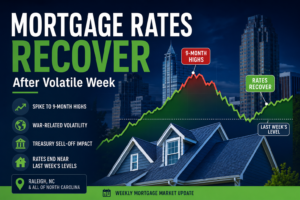
Weekly Mortgage Market Update: Mortgage Rates Recover After Hitting 9-Month Highs
This week brought the sharpest mortgage rate volatility since late March, with rates climbing to their highest levels in more than nine months before recovering by Friday. Earlier in the week, heavy selling in the U.S. Treasury market pushed bond yields sharply higher, which in turn caused mortgage rates to spike across North Carolina and the rest of the country. By the end of the week, easing geopolitical tensions and improving bond market sentiment helped rates stabilize near last Friday’s levels. For homebuyers and homeowners across Raleigh, Cary, Durham, Apex, and Wake Forest, the week served as another reminder of how quickly mortgage pricing can change in today’s market.
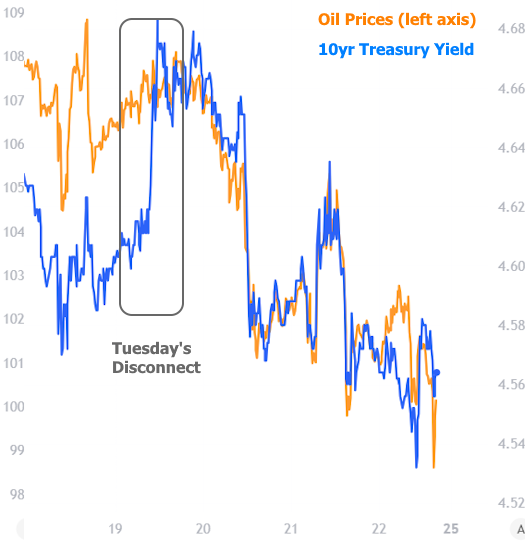
Mortgage rates are heavily influenced by the bond market, especially U.S. Treasuries and mortgage-backed securities (MBS). When investors rapidly sell large amounts of Treasury bonds, bond prices fall, and interest rates move higher. Mortgage-backed securities usually follow the same pattern, which is why mortgage rates jumped sharply earlier this week across Raleigh, North Carolina, and much of the country.
Trading activity suggested that one or more large institutional investors were behind the Treasury sell-off. While the exact reason remains unclear, markets reacted as if a major fund was repositioning assets within the bond market. Large investment moves like this often create sudden swings in mortgage rates, even when broader economic data remains relatively stable.
By Wednesday, financial markets began responding to improving geopolitical headlines and easing concerns surrounding the Iran conflict. Oil prices declined, bond yields moved lower, and volatility across the mortgage market started to calm. As bond prices recovered later in the week, mortgage rates improved and finished near the same levels seen last Friday.
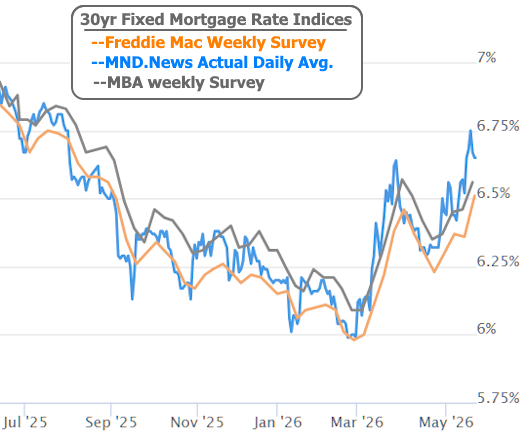
While rates recovered from the week’s highs, the market remains near the highest mortgage rate levels seen in the past nine months. For homebuyers, homeowners, and borrowers considering refinancing in Raleigh, Cary, Durham, Apex, Wake Forest, and across North Carolina, the week highlighted how quickly interest rates can change in today’s market environment.
Markets will return from the Memorial Day holiday focused on several key economic reports that could drive mortgage rate movement heading into June. Investors will closely watch Consumer Confidence, ADP Employment data, weekly Jobless Claims, GDP revisions, Durable Goods orders, and New Home Sales for additional signs of whether the economy is slowing or continuing to show resilience. Inflation data will remain especially important, with the upcoming PCE inflation report carrying significant weight because it is one of the Federal Reserve’s preferred measures of inflation. Stronger-than-expected economic data could put pressure on bond yields and mortgage rates, while weaker readings may help stabilize rates and support lower borrowing costs.
For homebuyers and homeowners across Raleigh, Cary, Durham, Apex, Wake Forest, and throughout North Carolina, this week reinforced how sensitive mortgage rates remain to both economic data and global events. Volatility continues to create rapid day-to-day changes in home loan pricing, making timing and strategy more important than ever. Buyers entering the market this summer should remain prepared for potential rate fluctuations and maintain close communication with their mortgage professional as opportunities arise. Despite the recent improvement from this week’s highs, mortgage rates remain near the upper end of their range over the past nine months, keeping affordability and payment planning at the center of today’s housing market conversations.
Recently Released Economic Data
| Time | Event | Period | Actual | Forecast | Prior |
|---|---|---|---|---|---|
| Tuesday, May 19 | |||||
| 10:00 | Pending Home Sales (%) | Apr | 1.4% | 1% | 1.5% |
| Wednesday, May 20 | |||||
| 14:00 | FOMC Minutes | ||||
| Thursday, May 21 | |||||
| 8:30 | Jobless Claims (k) | May/16 | 209K | 210K | 211K |
| 8:30 | Philly Fed Business Index | May | -0.4 | 18 | 26.7 |
| Friday, May 22 | |||||
| 10:00 | Consumer Sentiment (ip) | May | 44.8 | 48.2 | 49.8 |
Upcoming Economic Data
| Time | Event | Period | Forecast | Prior | |
|---|---|---|---|---|---|
| Monday, May 25 | |||||
| 0:00 | Memorial Day | ||||
| Tuesday, May 26 | |||||
| 9:00 | FHFA Home Prices y/y (%) | Mar | 1.7% | ||
| 9:00 | Case Shiller Home Prices-20 y/y (% ) | Mar | 1% | 0.9% | |
| 10:00 | CB Consumer Confidence (%) | May | 92 | 92.8 | |
| Wednesday, May 27 | |||||
| 8:15 | ADP Employment Change Weekly | 42.25K | |||
| Thursday, May 28 | |||||
| 8:30 | Jobless Claims (k) | May/23 | 212K | 209K | |
| 8:30 | GDP (%) | Q1 | 2.0% | 0.5% | |
| 8:30 | PCE (y/y) (%) | Apr | 3.5% | ||
| 8:30 | Durable goods (%) | Apr | 0.8% | ||
| 10:00 | New Home Sales (ml) | Apr | 0.67M | 0.682M | |
| Friday, May 29 | |||||
| 9:45 | Chicago PMI | May | 49.5 | 49.2 | |