Mortgage Market Update: Peace Deals, the Fed, and Your Mortgage
Rates began the week on a solid footing as prospects for the Iran peace deal continued to materialize. The market had mostly priced the peace deal into trading levels last Thursday, but reports of high-level officials actually signing the deal helped yields push to their lowest levels in a month as of Tuesday.
The week’s only meaningful volatility followed Wednesday afternoon’s Fed announcement. With this being the first Fed meeting under new Chair Kevin Warsh, one could consider that the market had a bad reaction to his approach. And while that claim could be made in a roundabout way, the easier claim to prove is that the dot plot did most of the damage.
What is the dot plot?
Concurrent with the January, March, September, and December meetings, the Fed also releases its Summary of Economic Projections (SEP). Within the SEP, you’ll find each member’s outlook for the target funds rate, shown both in a table and in the familiar dot plot. The dots have become a focal point for rate watchers. They’re a quick read on where policymakers think rates are headed.
Put simply: traders form educated guesses about how the Fed’s rate expectations will evolve as new data and events come in, and the dot plot either confirms or nudges that view.
This week, markets priced in the possibility of a rate hike by year-end, but with ample room for the Fed to hold steady. The dot plot not only confirmed that hike scenario, but it also underscored that traders should be even more prepared for a potential move higher.
The following chart shows where the dots were last cycle (in March) versus yesterday (June):
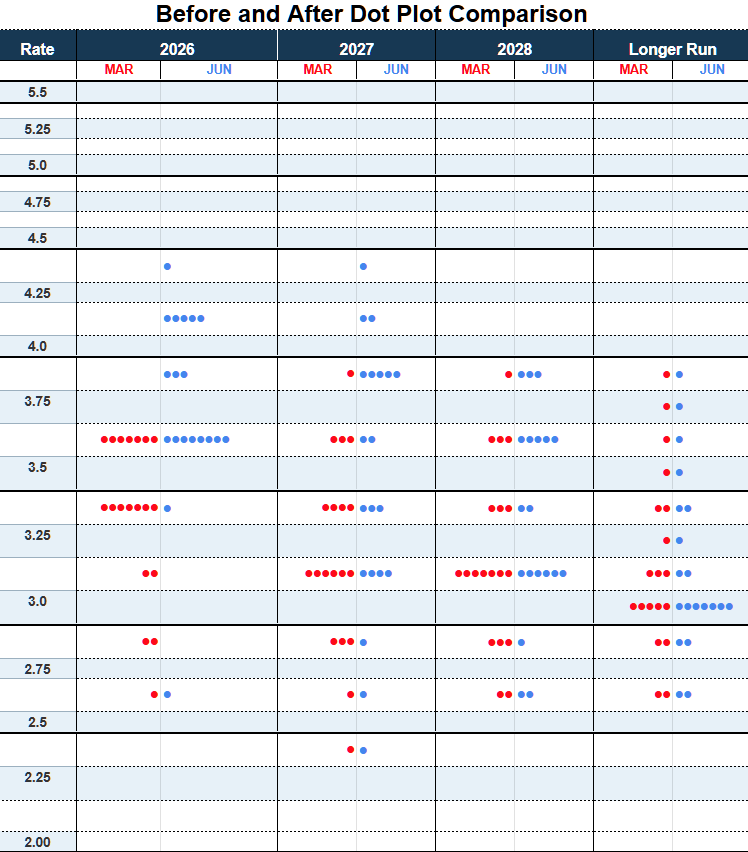
Focusing on the 2026 column, the median Fed member projected zero hikes or cuts by year-end back in March (3.375%), versus 3.625% this week. In the vote breakdown, 9 members flagged 3.875% or higher, while 10 votes were 3.625% or lower. In other words, roughly half of the FOMC sees two rate hikes by December.
Dots also shifted upward for 2027 and 2028. Taken together, the stance was more hawkish than the market expected, and the dot plot release at 2:00 p.m. ET sparked an immediate market reaction.
How did Warsh come into play?
Opinions were divided on Warsh’s first press conference, so we’ll stick to the facts and skip speculation. Contrary to many expectations, Warsh did not advocate for rate cuts or rate hikes. He also avoided commenting on forward guidance altogether.
Crucially, he didn’t push back against the hawkish message embedded in the dot plot. In past moments when the dots clearly pointed to hawkish or dovish positions, previous Fed chairs tended to frame the data in a more nuanced way during the press conference, helping to temper volatility on Fed Day. Warsh, by contrast, described the dot plot as “written in pencil, not in ink,” but offered nothing to suggest a more hawkish tilt.
Moreover, Warsh’s reluctance to engage reporters on any form of forward guidance left markets without a clear signal about how the Fed might respond to incoming data over the next six weeks. Some argued this heightened uncertainty warranted a larger risk premium, contributing to weaker trading levels.
How’d it all shake out?
By Thursday, longer-dated rates, such as 10-year Treasuries, had largely recovered, while shorter-term rates, including 2-year Treasuries, remained pressured. The shortest-term gauges, including the implied Fed Funds Rate from Fed Funds Futures, never fully recovered.
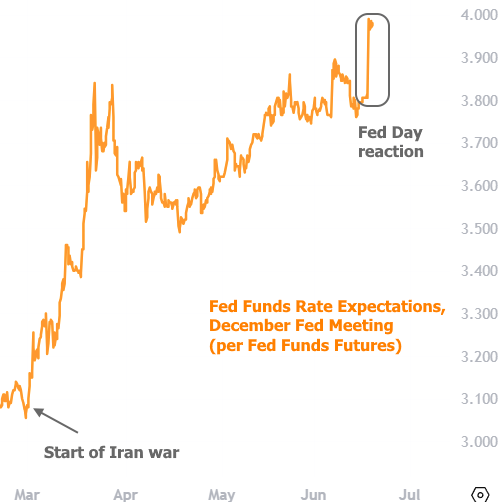
The chart below illustrates December’s expected path. The December rate price rose about 0.18% after the Fed announcement and sits roughly 1 percentage point higher than before the Iran-related tensions. Put simply: In late February, the market was pricing in two rate cuts this year; today, it’s priced in two rate hikes.
How’d mortgage rates react to all of this?
Fortunately, average mortgage rates tend to behave more like 5–10 year Treasuries than the ultra-short-term measures such as Fed Funds implied yields. They didn’t spike on Wednesday and managed to erase about half of those losses on Thursday. In the bigger picture, this week’s volatility was fairly uneventful, even though rates remain elevated versus the past 10 months.
What’s next?
Iran war updates remain important. While a memo was signed, official peace has not yet been confirmed. If peace holds—and if oil prices stay steady, mortgage rates could see gradual, additional benefits.
Beyond that, markets will slowly shift their focus back to data, with special attention to inflation-related numbers to gauge any lingering effects from the recent fuel price spike.
Navigating market shifts and changing interest rates doesn’t have to be overwhelming when you have a local expert in your corner. Whether you are ready to make a move on a new home purchase or looking to optimize your current payment through a strategic refinance, we are here to guide you every step of the way. Contact Certified Home Loans today, and let’s build a personalized mortgage strategy to turn your homeownership goals into reality!